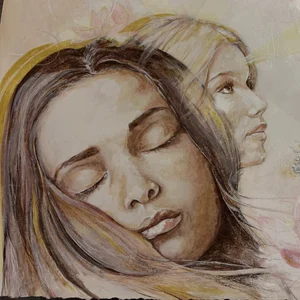
Radical Self Love…Becoming a safe enough home for all of who we are.
There are moments in life when growth feels expansive…beautiful, even. We recognize something about ourselves, feel an old belief loosen its grip, experience some new sense of freedom, and think, Ahhh…this is what “becoming” feels like.
And then there are the other moments.
The ones that rip us open.
The ones that pull back a layer we didn’t even realize was there and introduce us to parts of ourselves we would’ve been perfectly happy to leave comfortably tucked away.
A recent trip to Mt. Shasta was a little like that for me.
To put it quite bluntly, Mt. Shasta pretty much kicked my ass…said with love.
I arrived expecting a magical adventure and while it was definitely that, I came home to a rather unexpected deep dive into my own shadow where I ended up peeling back yet another layer of an aspect of self I’ve been unpacking for nearly thirty years now.
Looking back, I can see the divine orchestration of it all so clearly—the place, the timing, the circumstances, and especially the gift of having a powerful mirror placed in my life at exactly the moment I was ready to see what it reflected.
And I think ready is an important word to bring attention to because perhaps these deeper layers of ourselves don’t emerge simply because we’ve failed to heal them…
Perhaps they emerge because they finally feel safe enough to be seen.
This, at least, has been my experience.
It’s taken a hot minute, but I’ve come to understand my journey less as a linear progression toward some perfected version of myself and more as a continual peeling back of layers.
We see something.
We integrate it.
We soften.
We expand.
And eventually (and inevitably), another layer presents itself.
And this doesn’t happen because we’ve gone backward, friends. It doesn’t happen because the work we’ve already done somehow wasn’t enough. It happens because this incarnation continues to reveal itself to us as we become capable of holding more of who we are.
There will always be more to discover - if we’re simply willing to look.
Sometimes what we discover is beautiful…and other times it’s uncomfortable. Sometimes it dismantles the story we’ve been telling ourselves about who we are - that’s always a fun one.
Sometimes it feels like being ripped apart…and honestly, I think that’s exactly what’s happening.
A version of us that carried us this far can no longer carry us where we’re going, so something begins to come apart, to unravel.
What surfaced for me at Mt. Shasta wasn’t new.
These were patterns I had been aware of in different forms for years—perfectionism, overgiving, anticipating the needs of others, taking responsibility for things that were never really mine to hold.
I knew them.
I had worked with them.
I thought I understood them.
But suddenly, I was being invited to see them differently - not as evidence that I still hadn’t “gotten it.” Not even as wounds requiring another round of healing.
I began to see them as incredibly intelligent parts of myself that had learned a very long time ago, how to keep me safe.
And that changed everything because it’s easy to love the parts of ourselves we find beautiful. It’s easy to embrace our generosity, our creativity, our wisdom, our tenderness, our strength.
Radical love asks something more of us.
It asks:
Can you love the part of yourself whose behavior has caused you pain?
Can you love the part that overfunctions?
The part that controls?
The part that performs?
The part that believes it has to earn love?
The part whose survival strategies have occasionally gotten in the way of the very intimacy, freedom, or expansion you desire?
Can you look at her and resist the urge to make her disappear?
Because she isn’t the enemy.
She never was.
In fact, she was really damn good at her job.
This may be the most important thing I’m learning - that wholeness doesn’t require us to identify the less desirable parts of ourselves and lovingly escort them from the premises.
It’s quite the opposite, actually.
Maybe healing is finally opening the door and saying:
You don’t have to leave…You belong here, too.
The perfectionist can stay.
The overgiver can stay.
The one who learned to anticipate everyone else’s needs can stay.
The little girl who believed being exceptional might make her safer or more lovable can absolutely stay.
The shift is that they simply don’t have to work so hard anymore.
Their roles can relax moving forward.
And there’s something profoundly different about that: I don’t have to kill off an old version of myself in order to soften into someone new.
I can acknowledge her.
I can thank her.
I can hug her.
I can honor the extraordinary intelligence it took for her to become whatever she needed to become to keep us afloat.
And then I can assure her that I’ve got it under control moving forward…not because she was wrong, but because we’re safe enough now for her grip to soften.
There was another essential piece to this particular unfolding.
Sometimes we can’t see ourselves clearly without another human being standing across from us.
Relationships—romantic, platonic, familial, fleeting—have an uncanny ability to reveal what solitude cannot. And sometimes, divine orchestration places someone in our lives whose presence creates exactly the friction, safety, tenderness, challenge, or reflection required for something buried within us to finally rise.
That person isn’t arriving to fix anything…they simply hold the mirror.
And if we’re willing to look—really look—we may discover that what we initially thought was about them is actually an invitation deeper into ourselves.
This particular mirror allowed me to see some very old roles I had been playing.
Roles rooted in fear.
Roles rooted in survival.
Roles that had served me steadfastly throughout the years.
And roles that no longer needed to be held so tightly.
There was enough safety in the reflection for them to finally become visible, and that, too, is love.
Not someone rescuing us from ourselves, but someone whose presence allows us to encounter ourselves more fully.
I think we sometimes romanticize transformation.
We talk about rebirth and expansion and stepping into our highest timeline.
But rebirth implies that something has died.
Expansion requires that something which once contained us can no longer do so.
And becoming more fully ourselves often means watching identities, roles, beliefs, relationships, and survival strategies come apart in our hands.
There are seasons when this feels less like transformation and more like dismemberment…when we don’t quite recognize ourselves. When what used to work doesn’t anymore. When the old version is clearly no longer in alignment, but the new one hasn’t fully taken shape, and while that space can be a little scary at times, it can also be so very sacred.
And this, for me, is where radical self-love enters the conversation.
Radical love isn’t standing in front of a mirror and convincing ourselves that everything about us is wonderful.
It’s much more intimate than that.
It’s the willingness to sit beside ourselves when what we see is inconvenient.
To remain curious when shame would rather take over.
To recognize that even our most frustrating patterns were once acts of protection.
To stop dividing ourselves into the parts worthy of keeping and the parts requiring removal.
To say:
Oh, there you are.
I see why you learned to do this.
Thank you for getting me here.
You can rest now.
Maybe that’s what wholeness actually asks of us…
Not perfection.
Not transcendence.
Not the elimination of shadow.
But a willingness to keep widening the circle of what we’re capable of loving.
Again…and again…and again.
I honestly don’t think there’s a finish line to this.
I don’t think we reach some enlightened version of ourselves where nothing uncomfortable ever surfaces again. I actually think the opposite may be true.
The more willing we become to know ourselves, the more life reveals…
Another layer.
Another invitation.
Another forgotten piece asking to come home.
And maybe that’s one of the great gifts of being here.
This incarnation will continue revealing itself to us for as long as we’re willing to participate in the conversation.
The question isn’t whether more layers will surface - trust me, they will.
The question is what we will do when they arrive.
Will we judge them?
Try to fix them?
Hide them?
Spiritualize our way around them?
Or can we become spacious enough to say:
Come here…I’ve been waiting for you.
Because perhaps the deepest transformation isn’t becoming someone new at all.
Perhaps it’s becoming a safe enough home for every version of ourselves to finally belong.
And allowing all of them—slowly, tenderly, radically—to soften into the wholeness that was there all along.
This is radical self love, folks…and we’re all being invited to the party. 💗