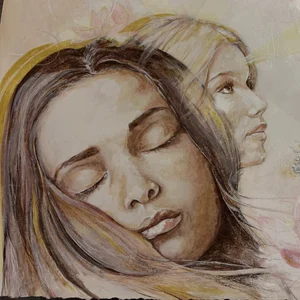
Authenticity: The Ripple of Living True…How living authentically becomes a form of collective medicine
There’s a quiet invitation that life extends to each of us — an invitation to live in our authenticity. Not as a performance or a personality trait, but as an embodied way of being. It sounds simple enough, and yet it’s one of the most profound and challenging callings we receive as souls here on Earth.
Authenticity asks something intimate of us:
it asks us to know ourselves, to trust ourselves, and to stay true to ourselves, even when the world around us is swirling, collapsing, or rearranging itself into something unfamiliar.
If these last couple of years have taught me anything, it’s that authenticity is no longer optional. It’s essential for us all.
Authenticity Begins with Self-Trust
Authenticity isn’t something we can force or declare. It grows from an inner relationship — from the slow and steady rebuilding of trust with ourselves. If I can’t trust my own knowing, my own desires, my own boundaries, my own voice… then how can I live in alignment with them?
Self-trust forms through the smallest agreements:
• the moment I honor my “no,” even when it disappoints someone
• the moment I follow my curiosity, even when it doesn’t make sense yet
• the moment I tell myself the truth, even when the truth is inconvenient or hard
Every time we do this, the inner voice says:
“Thank you for listening and honoring our truth.”
Every time we don’t, it says:
“I’ll be here waiting for you to come back.”
Authenticity requires that the self we present to the world is the same self we return to inside.
Chaos as Catalyst
Interestingly, it’s often chaos — not peace — that initiates this relationship with authenticity.
Chaos strips away the excess…it dissolves our personas, our coping mechanisms, our borrowed identities, our old agreements.
Chaos says:
“If the world is changing anyway, who are you now free to become?”
In that sense, chaos becomes an unexpected ally. It shakes loose all that is false so that what is true can finally be seen.
Sometimes we don’t find our true authenticity until the structures we once depended on fall apart — not to punish us, but to release us from everything we no longer need to carry.
Authenticity Under Judgment
Of course, authenticity doesn’t only exist in the inner world. Eventually it must walk out into the sunlight, into rooms full of people with their own opinions, expectations, and projections.
This is where many of us hesitate — not because we lack clarity, but because we fear the cost.
There is a particular kind of courage required to stay true to ourselves in the presence of judgment. It asks us to choose alignment over approval, resonance over popularity, inner truth over external validation.
Authenticity without witnesses builds confidence.
Authenticity with witnesses builds sovereignty.
The Belonging Paradox
As social beings, we are wired for belonging. But here lies one of the most painful and liberating paradoxes:
When we abandon ourselves to belong to others, we ultimately lose both.
When we belong to ourselves first, however, true belonging finds us.
Self-abandonment may buy us temporary acceptance, but it always costs us authenticity — and eventually, that costs us peace.
Belonging that requires contortion isn’t belonging — it’s performance.
Authenticity risks the loss of the wrong people so we can be found by the right ones who honor us as we truly are.
Authenticity as Purpose
We tend to think of “purpose” as something external — a career path, a mission, an offering, a legacy. But purpose begins much closer to home than that.
Our first purpose is to be ourselves without distortion.
Everything else grows from that soil.
Authenticity aligns us with the environments, relationships, and opportunities that are truly ours. It gives our gifts permission to emerge in their natural form — not the form that pleases or impresses, but the form that is aligned to our truth.
Purpose requires authenticity the way plants require sunlight.
The Collective Ripple
One of the most beautiful things about authenticity is that it never just benefits the person living it. It ripples. It gives others permission. It shifts the collective field.
When one person chooses truth, others remember theirs.
When one person refuses to abandon themselves, others feel less alone.
When one person speaks from the heart, the room exhales into honesty.
Authenticity is contagious — because truth feels like relief.
With all of this in mind, the question then becomes: how do we cultivate authenticity in our own lives, especially when it feels risky or inconvenient? The outer ripple begins with inner inquiry. The following prompts are an invitation to listen more closely to your own authenticity, as a gentle doorway back to yourself.
🌿 Journal Prompts — Listening for Authenticity
Choose one or consider them all over time:
• Where do I feel the strongest pull toward authenticity right now?
• Where am I still abandoning myself for belonging?
• What does my authentic “no” sound like? What does my authentic “yes” feel like?
• What becomes possible in my life if I tell myself the whole truth?
• If chaos is a catalyst, what is it trying to dissolve and what is it trying to reveal?
• Who am I when no one is watching, evaluating, or needing something from me?
• Where in my life do I currently feel most like myself? What qualities exist there?
🌼 Mantra for Integration: “I belong to myself first.”